
20. Departure

After decades of micro-predictability our family future was suddenly unguessable. We dealt with this in different ways. My sister and I were energised by new uncertainties that allowed us muddled, but cheerful, fantasies. My parents developed mind-crippling anxieties about where we would all live and how my father might supplement his Rupee-Pension with Sterling Earning. Their supporting consolation was that they were “True Brits”, long term loyal custodians of the Crown Jewel of the Great British Empire, and so would not only be understood and accepted but deeply respected and welcomed when, at last, they arrived at their true “Home”. For them life had become framed in the familiar pattern of their religion: endurance followed by joyous welcome into an indescribable better life. A brief intense anxiety was that we could not gain the welcoming goodwill that we expected unless we had British passports. My father’s Police contacts fixed this, and shabby blue-black booklets embossed with dingy false gold appeared, and were treasured and admired - particularly the inside covers on which Her Majesty’s Secretary of State used ornate script to Request and Require everybody not lucky enough to be British to treat us decently. Arrival of this affirmation is the last thing that I remember from a turmoil of packing shabby and ugly chairs into hessian netting, cleaning the bone-inlays in a small occasional table that I still have, and personal negotiation of a sale of the sparse family books to Vishnu Vasudeva’s family.
Suddenly we were at a dock with two old family friends, Blanche and Eileen Bell, teacher ex-colleagues of my mother. We had given them all the hopelessly surplus household objects and they had loyally come to see us off. Benji was zipped into my sister’s little oilskin shoulder bag. He did not like this and began fiercely to wriggle and gnaw. The bag twitched and bulged but the customs people, dock-police and sailors did not notice. Like a staunch drug-mule, Sheila trotted through dim metal ship-corridors to our cabin where we shut Benjamin into the top compartment of a wooden clothes cupboard where he immediately began gnawing for release. He kept this up for the next 3000 miles and 21 days, and came within a few splinters of becoming noticed as flagrantly illicit, and probably “put down” by maritime pest control.
After inspecting a dark, stuffy, tiny four-berth cabin we decided that my sister, mother, old Mum and I would share it while Dad and old Dad found another to sleep with strangers.
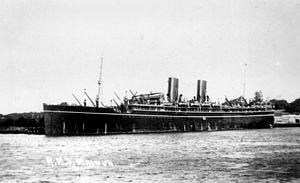
The cabin was too small to celebrate the distinguished moment of departure from India, so we moved to a public space on the upper-rear deck where there were chairs to watch whatever there was to see. The SS Maloja had already travelled all the way from Sydney, via Cape Town, and now lurched from the Bombay quayside with engine-grinding, splashes and groans. It was dusk, and street lights began to shine, leaving trails of glints on the water. Old Mum squirmed in a too-small wicker armchair, became excited at their fading and named them as the “Pearls of the Orient”. I wondered where she had found this uncharacteristically romantic phrase and though I tried I could not fit it to a lurching horizon of lamps, fading in greasy darkness until there was nothing but nauseous black sea.
Maloja swayed, Old Mum began to feel very ill and found her way through dark stairs and passages to our cabin where seasickness kept her for most of the next twenty days. I also became sea-sick and soon followed to squirm in my bunk unable to sleep because of the sour stench of her and my sister’s and mother’s and my own vomiting, the creaking and splashing and lurching of the ship and the tireless crunching of Benjamin’s escape project. I began to worry how long I could bear dark sour fug with groans and acute bowel discomfort and tried to ignore, in the stale lurching mornings, offers of breakfast that none of us wanted.
More than seventy-five years later, my memory cannot arrange the rest of our journey into a neat sequence of experiences in time and places: only a shuffle of mind-shots without sound effects. I must have spent most of my time in the deck-lounge from which I could see the horizon, a ruler-straight line between darker and lighter blue. Sometimes there was another vessel, a curved-and-pointy-sailed Arab dhow or another steamer. Rarely there was a grey distant whale-hump, more often just a spout, like a burst of steam from a submerged locomotive. Whenever this happened people crowded to the nearest deck-rail to marvel at being so near to the huge, careless creature.
A more substantial entertainment was a cupboard of scruffy books which included many by P. G. Wodehouse. I sat in the deck-lounge and read them all, as rapidly and inconspicuously as I could, but drew embarrassing attention by sudden bursts of laughter at Lord Emsworth’s pig-obsessions and Bertie Wooster’s idiot friends. Reading was not just my usual escape from boredom: It had become formal, self-conscious research into how to become more British. A less congenial mentor than Wodehouse was Dornford Yates, who had written several thrillers such as Berry and Co and Jonah and Co, describing a close-knit extended family of firm-jawed straight-left-punching British quasi-aristocrats grappling for advantages over lower class villains with poor personal hygiene (they were often “oily” and sometimes Jews or other Levantines). These True British Heroes shared quite funny jokes with each other, even when under pressure from wicked interlopers, who were often scheming women, and always desperate aspirants to a class-status to which they were not entitled. So obviously inferior in morals as well as in biology and gender (Dornford Yates seemed to be sceptical, or at least very wary, of most females who were not “true” and “decent” and, at least upper-middle-class or, even better, or loyal, and slightly comical “lower class” servants). The badinage between Berry and his family and friends was entertaining and seemed to offer useful tips on how to pass as a Brit rather than, as I was beginning to accept, an instantly recognisable and undesirable “crypto-Wog”. I knew already that I could never develop a lethal straight left but, at least I might learn how to be amusing in a British way?
My realisation how futile it was for me to try to learn how to fight like Berry and Co was emphasised by an Australian Rugby team on a long journey to out-manoeuvre and damage as many consenting North Europeans as they could find. They had become bored since leaving Sydney and, for entertainment, began to search out and size-match pairs of small boys, put boxing gloves on them and provoke them to hit each other as hard and skilfully as possible while they made bets and shouted advice. I knew that this was a very bad idea and was thrashed by a small, hard, fast-moving Australian child. Having offered me the apt insight that I “minded pain too much” the Rugby players ignored me for the rest of the voyage.
Sea-sickness relented and I began to enjoy exotic British food, such as kippers, that I had never tasted before. Also to become aware how the suave stewards and other passengers subtly indicated that my family and I were very different from, and much less desirable than Australians, (who qualified as “near Brits”) and how impossibly far we all were from being the elite, real thing. The stewards were particularly good at highlighting our difference by feigned politeness. The first cue that betrayed us was our accent. All through our lives we had smugly mocked the “Chi-Chi” accents and locutions such as “going to go” and “coming to come” of Native Indians who were superbly articulate in versions of English that had evolved far beyond our 19th century Victorian Raj-speak. Now we were shocked and distressed to find that, within centi-seconds, we were identified as “not the right sort”, equally by cockney-parody Australians and by sneakily supercilious “genuine” Brits. I began to understand that, unless I worked hard at it, I might spend the rest of our lives as a comical aspirant to an un-attainable status. Like gentle and generous Mr Lackadawallah who, I now think, was being shrewdly playful and subtle, hinting the impending end of the Raj by continuously singing:
After the ball is overreh
After they all have gorne..
Happy alone in the twilight,
….I sit and linger orne..
The idea of White- (or Beige)-Entitlement that had supported our lives was turning into bitter private irony. P. G. Wodehouse’s and Dornford Yates’ instruction manuals might be helpful, but they were obviously flawed and incomplete. Comical pride, affections for pigs or affable stupidity were not enough for me to learn to impersonate the individual I had always felt myself to be. I quickly recognised that, as I had always known, I did not have a “square jaw” or a “lethal straight left” and was now learning that to master the stilted badinage of the Drones Club and the joke-themes of people hallmarked as true-Brits by Dornford Yates and “Sapper” was going to be no help at all.
Fabulous storytelling, Pat. I wondered whether you'd seen this: http://www.youtube.com/watch?v=QoCS8fTVUgI including the comments. Caroline