
23. Scotland

The train journey gave exciting moving-ribbon views of green countryside with a greater variety of meadows, small woods, streams and interesting little towns than I had imagined possible in this tiny, cramped new country. Much more promising than the grey streets of Rochester.
I saw Old Dad in hospital, dying of pneumonia, only once, before God yet again made it clear that S(He) makes no deals. It was strange that Old Dad called me “Patter”, as he had when I was very little, touched me, as he never usually did, smiled as gamely as he could and seemed to still like me and to be glad to see me. I was not taken to his funeral. Nobody seemed upset by his absence. Claude had never known him, Ivy had not met him for at least 20 years, my grandmother hated him and he had been so self-effacing in our family group that my parents seemed to be unaware of his loss. Probably he had also realised that his death would solve problems because he would have been surplus in a house with only three bedrooms that must be shared by two families, comprising eight people. The right of my grandmother to a room of her own was un-challengeable. So Dad, Mum and my sister Sheila shared the biggest bedroom and I was delighted with a box-room which had no window and was just big enough for a bed and the vertical cylinder of a pungent Valor kerosene heater. Ivy, Claude and Kenneth uncomplainingly agreed to share the big, cold attic, probably because my father paid all or most of the rent. There was a single indoor lavatory and bathroom, a common living room and a kitchen. Old Dad must have realised that, in this new world, he had run out of space as well as time.
I missed Old Dad, but less than I had expected, or than he deserved for being a pivot of my childhood happiness. My distractions from grief were timid struggling to learn a new life and the danger of remembering a past in which he had been a cheering, and cryptically affectionate, presence. Also, all the adults in the house simultaneously contracted scabies which demoralised them with intolerable itching and poor health and spirits.
I was legally obliged to be sent to a school but there was none nearer than Edinburgh. My parents thought that because State Schools were free they must also be academically inadequate - they were certainly un-Catholic. They randomly picked George Heriot’s, an old and quite famous school in the centre of Edinburgh. It was not Catholic but made up for this by the prestige of being much more expensive than they could afford.
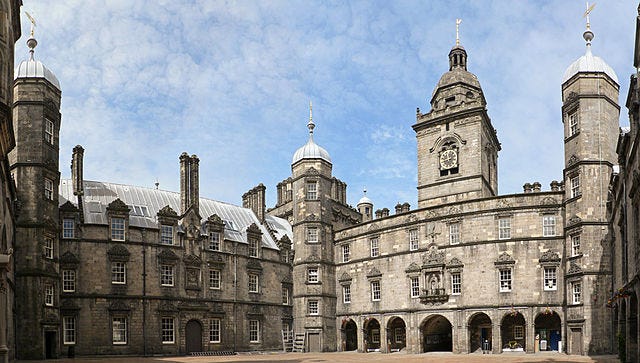
I am still embarrassed at the burden this must have been to them, particularly because in contrast to their growing misery nothing happier could have happened to me. I recall Heriot’s as a grey, granite castle-form structure surrounded by peripheral settlements of low, classroom buildings. At first I did not dare to speak to anyone because I was scared that my accent would mark me as an alien deserving instant scorn and aggression. I was soon identified as having a “touch of the tar brush” but less despised for this than for being fat, small, weak and awkward (so they called me “Tarzan”). In spite of these inadequacies they began to accept me as just another boy, whose shortcomings were not necessarily racial. I only signalled ethnic peculiarities in rare lapses of vigilance.
One of these happened when a beautiful female undergraduate at Edinburgh University was allowed to use my class for what I now realise must have been her student project: to discover what Scots children thought about citizens of other countries now that the bitter World War was over. She gave us all a questionnaire to check our feelings about a list of nationalities. Everyone hated the Germans and Japanese and liked the Russians more than the French or Americans. The questionnaire offered only one slot to rate all “Indians”. I found this absurd and expanded the list to distinguish Mohammedans, like Pathans, (mostly very brave and aggressive but not very clever), Hindus (clever but unreliable, and usually cowardly, except for fierce, martially-gifted sub-categories such as Dogras and valiantly combative Maharattas). There were also Sikhs (big men with distinctive turbans, excellent warriors and Security Guards and all-round decent chaps), Nepalese (admirable soldiers and mountaineers and always cheerful), Assamese (nearly as fine as the Nepal Gurkhas), Tamils (brilliant at cooking dhosas and very fiery curries, very dark but not otherwise distinguished) and Bengalis (far too clever for their own, and everyone else’s good). Not to mention mixed races, like Portuguese/Indian Goans, (tricky, overbearing and needing careful watching).
Of course I am now embarrassed by these foolish stereotypes. Then I felt that the nice lady needed to realise that the people of the world are far more complex than she thought. As I deserved, my classmates taunted me for weeks - mostly for blatant showing-off but also because my gesture asserted and highlighted my own racial peculiarity. So they teased me about which of these, unnecessarily differentiated, sub-categories of Wog I was, and invented witty attributes to define my sub-species. Like boys anywhere, they instantly recognised, and scorned, any symptoms of my daring to be overweening about my differences from them. They knew my weaknesses and made it clear that they would taunt me much more harshly if they wished, but this was only what they did to anybody who made efforts to become conspicuous.
Those who taught us were the kindest whole-white adults I had ever met - almost as gentle and clever and civilised as Parsees. It took me time to notice, and then gradually to appreciate that they felt that their job was to teach us to become as as they were by offering us interesting information rather than by indoctrinating us with weird religious fantasies or forcing into us stuff that they clearly found as dull as we did using anger, chastisement and threats of eternal damnation. These teachers also felt that to be, or at least to seem, friendly to us was part of their job. For example, Mr McKerrow remained patient and unthreateningly ironic even after he gave up trying to re-teach me Latin.
My life became happy in other, unpredicted ways: my daily bus-journeys between Edinburgh and Carlops unreeled moving-window vistas of fields with dense flocks of lapwings shrieking “pee-wit” (their local name) loud enough to drown the bus-rattle. We could also hear, but never saw, curlews (click here for sound file). Leaving the magnificent fauna of India, I had worried that Britain was without any wildlife. But behind our house there were occasional partridges and hordes of round, brown rabbits that lolloped and scuttled on the far-side of an end-of garden burn teeming with caddis larvae, sticklebacks, tiny trout and seasonal tadpoles. These tiny creatures now seemed both comfortable and exotic, unlike the lavish feral lives in India that I had ignored except when my father and Uncle set out to kill things.
Beyond the garden-boundary-burn was a glacier-scooped valley with humps of small drumlins covered with grass that was so thick and slippery that even when there was no snow we could toboggan down their slopes on the house ladders.
This was marvellous for children but not at all for adults. My mother had never in her life cooked a meal and her first tries were disgusting failures that she self-punishingly ate after everybody else had refused. We all lost weight very rapidly. For me this was fine – I was soon no longer conspicuously fat. It was becoming clear that our family income was far from enough to support any lifestyle that my parents had imagined. My mother tried to supplement my father’s pension by teaching but could only find an extraordinarily stressful job in a school for uncontrollable screaming and distressed learning-disabled children. She gave this up. My father tried his best but could not find anything other than to visit, with Claude for support, all of the barber shops he could find in Edinburgh to try to sell them small plastic radio-sets. These, if you worked out which buttons to press, could also act as speaker-phones between adjacent rooms. Dad and Claude trudged round the Edinburgh barbers but never talked about their encounters. They sold nothing, but their tiny brown demonstration set became the centre of our family life. It delighted me with Uncle Mac’s 5.00 p.m. Children’s Hour and even more with Dick Barton- Special Agent immediately after. These special children’s programs came on just as the bus dropped me to scuttle through sleet into the communal room. Later there would be comedy shows like Tommy Handley’s It’s that Man Again and Kenneth Horne’s Round the Horne. There had been nothing so fine on the radio in India and I took these as authoritative guides to Contemporary British Culture. I don’t think that my parents understood, or even listened, even when Christmas came round with special programs in which the casts of several different shows were mingled into joint productions and used each other’s catch phrases. I thought this was a peak of witty sophistication but no-one else found it amusing, let alone joyous, and it did not distract the adults from deepening depressions. Claude, Ivy and Kenneth seemed to prefer their attic to the company of people and radio programs that they did not like.
I began to realise that I was in the first school in which I had ever been happy with companions who were as sceptical and mocking as friends should be. Even better than being at school was the bus journey there and back that soon became whited- out by amazing snow that I had read about but never seen. I did not realise that days and sunlight could become so very brief or how different seasons could be from each other or how fast they could change. To try to ease the contrast between my growing happiness and my parents’ misery I would offer them almost-accurate stories of my new life, the strange surnames of my friends (they seemed to find “Borthwick” and “Dudgeon” particularly funny but to have no idea how ridiculous it is to be called Rabbitt). I could mildly amuse them by telling how School Assemblies began with bagpipes played by a pair of adolescents in full Highland Dress, and by inventing hopefully-funny tales about how many boys wore sporrans and what they kept in them. My mother continued struggling to produce awful meals and I mocked her for being a “Holy Christian Martyr” by abjectly eating them herself. I felt personally responsible for my parents’ low spirits but, of course, I could not help them from withdrawing further.
I do not understand why, for me, birds often lever sudden breaches of reality. In India Shite-hawks could fracture time. Here dense crowds of squealing pee-wits jerked me into joy and invisible, plaintive curlews, suggested but did not provoke, causeless melancholy. One dusk a fine thing happened as I was walking alone through the mock-castle keep of Heriot’s old building after ineffectual “Extra Latin” with Mr Mc Kerrow. A sudden burst of wonderful happy whistling was my first experience of being slid out of the world by a blackbird’s flute. I keep constantly alert for this to recur and, during the next 75 years it sometimes has, but never again so astonishingly.
Heriot’s made me sensitive to a new idea of what school-teachers can be. I recall a remarkable Biology teacher, the first person to make me realise that we are part of a natural world that is astoundingly abundant, complex and inter-connected and that these astonishments can be revealed and understood by reading books that assemble vast and wonderful puzzles. This cheerful and gentle Biologist transformed my ideas about how much there is in the world to understand and how we can go about understanding it, and why some bits of information about the natural world are more illuminating than others. Much later I was sad to hear that the school had sacked him for, just once, taking some older students to a pub. I am certain that this was a harmless outing with none of Father Paul’s furtive calculation or even any under-age alcohol consumption. I think that he did it only because he craved affectionate acknowledgement from adolescents in his care and wanted to illustrate a harmless pleasant time. Perhaps the school had to reckon that Edinburgh families were notoriously straight-laced.
There was also an extraordinarily articulate Arts Master who, with no warning, spent his ninety-minute post-lunch-class lecturing us on the dangers of re-heating left-over food. Perhaps he was testing just how far, and for how long he could abandon his business. He seemed wonderfully coherent and eloquent about a desperate nation-wide need for food-hygiene and concerned for our welfare. In spite of all this knowledge and good-will he disappeared overnight and we heard that he had become ill and died.
These unusual grown-ups seemed to want nothing from us but to share information that entranced them. They were not “in love” with boys, but lusted to pass on facts and relationships between them. Perhaps, also, they had affection for the condition of boyhood rather than for individual pupils, and perhaps they hoped for an intensity of personal validation that they could only get from the young. We all recognised, and many of us exploited this possibility - some with fascination mixed with sympathy and scorn for its futility. We knew that our current boyhoods were just works-in-progress towards growing up, but recognised transience without plans or preparation to become adults. Magpie Nuns, flogging Irish Brethren and aloof Jesuits had all seemed convinced that childhood is a perilous condition that must be cured as soon, and as strenuously as possible by doses of Religion, Latin and Sarcasm. My first teachers did not envy, and so had no wish to share our inferior states of being but just tried to rush us as fast as possible into their grey universe that they obviously disliked. Nuns and Monks and Priests had seemed to be as bored with their lessons as we were and to treat them as a training-gym for a religion with which they were obsessed. I was surprised to find myself becoming happy. But then, as it always does whenever we think a particular bit of our life will last for ever, everything suddenly changed.
Golly gosh. A cliffhanger! I might have to suspend the WYSIWYG editing to relieve the suspense. Marvellous writing again. Caroline