
25. Girls

My father’s unease with my increasingly separate life went beyond his dislike of any infiltration of my new friends into our peculiar household. My mother maintained contacts with local Catholic clergy who, very occasionally, paid duty visits when she was honoured to make them tea and to humbly listen to any conversation they generated. I was an obvious topic and my adolescence provoked sneaky Pastoral suggestions that I was getting old enough for my future to be regulated by intensely supervised interactions with Authenticated Catholic Girls at a Proper Catholic Youth Club. Pious young females, enraptured by frequent Ceilidhs, might conspire to join with me in the Holy Sacrament of Marriage to produce a harvest of new souls for our Holy Mother the Church. In many senses I did not like the sound of Ceilidhs but I was impressed by the idea of Youth Clubs as venues for meeting actual, live, girls who were not my sister, her boring friends or even the pretty, inaccessibly tacit, public librarian with whom I was hopelessly tongue-tied.
Things worked out well and with half a crown for entrance money and bus-fare I was allowed to prospect non-denominational youth clubs as far away as Chatham and Gillingham. I did, indeed, meet girls and learned to un-tie my tongue in their company. I did not realise what a momentous transition this was until one day I was walking past the Post Office in Rochester High Street and met, and briefly greeted and laughed with a girl I only slightly knew. My father suddenly came out of the Post Office, saw us and went furiously home to lurk, outraged, in his Football-Pool Room preparing his most furious and prolonged verbal attack ever. I was frightened, angry and depressed, but not surprised because, without ever having being overtly told, I tacitly understood that I was forbidden to speak to random girls, let alone to appear, however innocently, to be on friendly terms with any . Since I was six my grandmother had puzzled and intrigued me by stressing that I must never meet, let alone associate with women she referred to as “Nymphomaniacs” who would “Ruin My Life”. I have never been lucky enough to meet any nymphomaniacs, (who sound rather jolly) and the few women who have generously tolerated me have enriched and enhanced my life. So, though I was prepared for Dad’s rage I was shocked at its intensity, and I did not understand how it could apply to nice, cheerful, Pauline.
For both my father and myself this was a critical moment of recognition that we had moved into different worlds between which it was not just difficult, but perilous to try to communicate. We had shared the common years of our lives in India and still lived in the same house but somehow we lived in entirely different towns. For my father Rochester was a wasteland where he was deprived of self-respect. He had mastered the street plan and some bureaucratic survival rules but he could not manage to find pleasure or even comfort in increased familiarity. I did not miss, or even think about the intense colours, the raucous birds, the cries of street-sellers of water and sweets, huge high clouds in a hot blue sky, shabby sun-fragrant great mango trees, powerfully loathsome smells or the unique senses of humour of Indian friends. I had, instead, a wonderful Public Library with its friendly smell of decaying books and kind Esme, who let me take out more than my quota and did not fuss if I returned them late. I also had the Casino roller-skating rink where I worked every evening for thirty shillings a week and tried to impress girls. Our transactions never went beyond my taking their money for loaned skates but the Casino enriched my life in many other ways - it liberated me from any need to depend on pocket money from my family and this joblet was an acceptable excuse for not being at home in the evenings and simulated a social life with strangers of my own age.
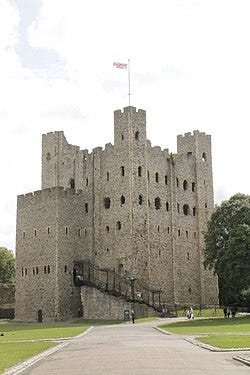
Rochester was a twee city with a grim Norman Castle Keep near a dignified park called The Vines which has a colonnade of impressive trees. It also has a gentle red-brick ex-Huguenot housing precinct and a gloomy mansion, once lived in by Charles Dickens, known as “Miss Haversham’s House”. I had imperceptibly become comfortable with the idea that I was now an authentic Brit and part of an intense and richly documented race-history.
This was mostly achieved by random reading that included T.H. White’s remarkable The Once and Future King and his other hyper-patriotic title England Have My Bones. I loved White’s fun with re-cycling of Arthurian myths but missed though silently absorbed an underlying ideology that, nowadays, would be called Fascist - Nationalist. One of my school-friends, Nick Cash, still alive and communicating, had a schoolmaster father who had known Henry Williamson. This led me (again with Esme’s kind help) to work through Williamson’s WW1 memoirs, The Flax of Dream and, eventually, Tarka the Otter which I did not much like, especially the cruel end which seems to relish, and not just comment that pain and cruelty are “part of nature”. I am now ashamed that I so easily assimilated Williamson’s world-view. His romantic fascism was less insidious than T.H. White’s but I quietly absorbed it, momentarily put-off by his account of pleasuring his cavalry mare with his forearm during a lull in his WW1. It is embarrassing to realise that what I learned to intensely believe when I was 16 and 17 makes me still not only recognise but understand the intensity of romantic illusions that the English extreme right still cherish. As in all withered love-affairs to understand does not revive emotions but does force one to remember and to acknowledge some illusions. I now realise that the romantic patriotism I felt was the identical literary artifact that still drives destructive nostalgia and change-anxiety in True Brits. Then I felt I had, at last, discovered the right text-books to show me how to become authentically British ; not just a licensed resident but with fervent, historically-licenced allegiance. Now, talking with Whole White British contemporaries, I find references to this literature are not only acceptable conversation-ornaments but also markers of the degree to which “Britishness”, and indeed “Great” Britain are literary inventions. To sample this huge, compelling literature is not to awake to something that we once were, now are, or can become in the future - but It is a useful clue to the strange hopes, fears and exaltations of identity in this invented country of the mind.
I fell passionately in love with the English countryside (though, in comparison with India, it was a toy-garden grown in a bottle and fast failing even in 1953). I no longer missed (or even thought about) the dense Bombay Ghat jungles or massive Himalayan deodars and steep rugged hills. Now I do not at all like my memory of the person I had become but then I felt extraordinarily lucky to have something to passionately believe and could use to light up a shabby, but increasingly cosy little world with illusions of significance. I somehow managed to convince myself that even I was, authentically, part of The Grand Epic of Britain that was symbolised by Rochester’s nubbly, rectangular 12th century castle keep, by which I sat for hours watching the brown river Medway. The books I was reading fostered convincing illusions that I, too, was a part of an elite sub-set of humans made exceptional by centuries of a brilliant, misunderstood and confabulated history and, caught up by this delusion, I lost any feeling of connection with Joe Rabbitt, sweating and dying in 1817 for East India Company share profits, or with my railway ancestors, getting up very early in warm dawns, coughing sharp coal smoke and wrestling huge spanners to service hissing engines. My new illusions made me happier than had the Irish Catholic guide to human existence - a brief hard time on middle earth followed by unimaginable agony or triumphalist reward. It was becoming impossible to share the mental life of an unbearably loving and sporadically ill-tempered father whose best argument for the truths of Roman Catholicism had become “So who else is going to bury you ?” – as if deaths and funerals are key events that ,retrospectively, define our entire lives.
I should have let my resentment of the Catholic Church quietly fade but self-importance demanded that I must make some pretentious gesture of public rejection. My father knew me too well to be interested in discussing my mental life and shut down arguments by jeering. I needed to find, to histrionically confront, and ideally, to spectacularly confound some Officially Licensed Opponent. The only one available was a quite gentle and humane senior priest in the church we attended, Father Riodan.
I made a formal appointment to discuss my problems with “My Faith”. No doubt dialogues with conceited adolescents were routine inconveniences of Riodan’s job. I turned up at his vicarage, was sat down in a clean, austere room and given a cup of tea. He was benign, even welcoming. I think that he expected that I had come to bore him with talk of discovery of a “Sacred vocation” and that he was prepared to be sceptical but without entirely discouraging a crisis of self-importance. Pompous bad manners and ill-nature made me blurt that I did not believe in his religion, or in any other, and that I needed to debate why either of us should persist in so obvious a farce. In silence he politely showed me out. I noticed that, on the table alongside the un-drunk tea, there was a plate with a few ginger biscuits. I wondered whether he would have offered me one if I had complained of soul-struggles for enhanced sanctity. Recognition of my pretentious vanity made me dislike him for exposing it. He must have died soon after because, when I next visited the Church, under protest to my family, I found his new, very solid, gravestone by the entrance. I was mildly sorry and recall that, for a moment I, thought that though his marker was not ostentatiously bulky or elaborate it was such a solid piece of work that he would have a struggle to get out from under it on Judgement Day .