9. Naini Tal and the wide world

I remember arriving at Kathgodam, the last foothill station before Naini Tal. I cannot image Naini Tal station but a flash-memory still freezes a moment when I first looked down over masses of dark conifers and rectangular bungalows and saw a great shining oval lake, the exact blue-grey colour of the sky set at the bottom of a huge bowl of cool air. It was so big that sailing boats moored at its edges seemed a too tiny to be real. I also do not remember my first glimpse of the shoe-box-shaped, grey pebble-dashed buildings and gravel “playgrounds” fenced with nets of chicken wire woven in an octagonal grid-pattern that were to become the stage-sets of my new world. Nor can I remember first encounters with any among the boys of my own age who soon became more familiar, and more consequential than my lost family. I do remember my first sight of the dormitory hall, a bigger room than I had ever seen, with ranks of beds under a featureless white plaster ceiling that disappeared when the lights went out, leaving safe darkness in which, during these first nights, each alone and anonymous in the night, we began to realise and be discomforted by things we had been too bewildered to acknowledge. Small sobs began from the beds around me. I do not remember whether I too cried, but I certainly thought about it.
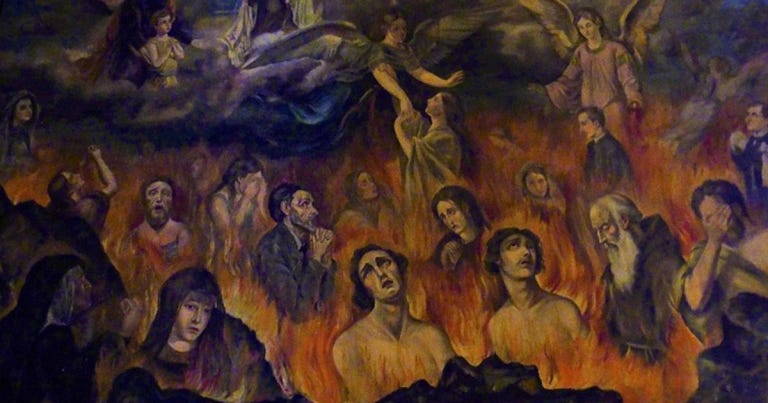
In the morning we were woken earlier than was comfortable with no time to think about anything before we were bustled into a washroom with long, parallel rows of wooden benches inset with oval tin basins. We each had a cloth bag marked with our names holding a cake of nasty pink Lifebuoy soap that smelled and tasted of tar and which, in the washbag, had got on to our toothbrushes and made them taste even worse than did our cakes of solid dentrifice powder in round, flat silver tins. We were each assigned a particular, permanent basin. Mine was under one of the dark walls below a lithograph of a place called Purgatory.
I was later taught that Purgatory is a detention centre for immigrant dead, who have not been wicked enough to be sent to Hell. In Purgatory they could qualify, after more time than still-living humans could imagine, for visas for a marvellous place called Heaven. We could later estimate that the durations of average sentences in Purgatory must be unimaginably long because we were encouraged to negotiate advance-reductions of our own inevitable tariffs, while we were still alive in this middle-world, and to shorten the times spent by acquaintances who had already died and arrived there by saying special prayers, each of which had a different time-remission value. I think that the little, four line “Glory Be ….” prayer was an extremely efficient way to gain 50 days remission, that “Our Fathers” and “Hail Marys” were worth a little more and that strenuous and conscientious runs through a rosary could commute decades of agonies. Some prayers and offerings of sustained acts of virtue could remit 50 or even 100 years - a lesson that even unambitious sins could bring about accumulations of Purgatory sentences far longer than the Earthly lifetimes spent committing them.
Any soul who had been bailed out by prayers by the still-living had reason to be very grateful, because the washroom lithograph showed a dark cavern filled with naked, screaming humans each enveloped in a personal tornado of red and yellow fire. You could guess that men and women were equally represented by differences in features, hair-length and some secondary sexual characteristics but the flames hid all possibilities of prurience and must have been ferociously painful about the parts which schoolboys most wanted to glimpse. I puzzled how hair could stay unignited but realised that, like most holy things that I could not understand, this was special fire, and just another Divine Mystery.
When we had washed and scrubbed our teeth with dentrifice we dressed and went downstairs to walk in procession to a church where there was Mass. We joined in, repeating fragments of Latin liturgical responses that we gradually learned to anticipate and even to partly understand.
The half hour of Mass seemed endless but the great trick of living in school was to speed your mind through long tracts of undesirable time by thinking about all of the other things that seemed important: which of the boys and, more significantly, which of the nuns seemed currently affable, indifferent or hostile; what would happen in class when homework was tested to failure and what might be for lunch (breakfast was always, predictably, tea and bread and margarine). We would be reminded to pray for the Pope and to ask God not to allow the Imperial Japanese Army to reach Naini Tal, or any of the towns in which our families lived. It was, of course, certain that the Allies would win in the long run but we also knew that bad things might happen to us, personally, before this. We were encouraged to pray to become better people. We obediently made this request but had little idea what changes would be necessary, would cost us, or how we would notice them - except that, hopefully, we would gradually find praying less tedious. I also prayed that the more savagely eccentric nuns would not notice me, if only for the duration of the new day that was just beginning.
After breakfast we crocodiled to our classroom behind our only teacher, Sister Herminia. Like all of the nuns, she was German and so spoke with an odd accent, but fiercely and efficiently sub-edited English essays and knew all about long division, fractions and decimals. From our point of view she was very tall. We knew she was blonde because lovely wisps of hair escaped the edges of her coif. She was mainly placid, in a firm way, with only brief fits of frustration in mid-afternoons. Most of the nuns were much worse-tempered, but we easily understood that grouchiness can happen to people sentenced to be shut up in the school not just for 9 months at a time but for every remaining year of their entire lives. We discussed whether Herminia, being so ostentatiously German, might be an Axis Spy but rejected this interesting idea because we could not think of anything that she could usefully report to the Reich, or even to their Japanese allies who were now rapidly scrambling through Burma towards us.
A useful thing that we all quickly grasped about life in boarding school was that counting, or brooding on a wasteland of oncoming identical dull days crushes the spirit, so we did not do this. Only a few of us became so resolutely unhappy that they developed fantasies of escape. Most of us thought how marvellous it would be to suddenly and completely escape our current realities - but soon gave up because we could not imagine how to do this. A greater problem was that to make big, alarming changes in their lives people need excuses, stories to explain to themselves that no other, more timid, decisions are possible. Like many things in boarding school these were excellent lessons for the rest of our lives. Only a few of us were so brave, or unhappy to brood fantasies of escape that could be nourished into convictions.
Three, aged 7 and 8, convinced themselves that the Japanese Invasion of India would suddenly and completely succeed and that the Convent would, of course, be a prime objective for notorious Japanese ruthless war crimes. Like many of us, these were children in families who had worked on the railways for generations so they easily blagged their way on to trains from the station at Naini Tal to Kathgodam and knew well how to negotiate beyond through the vast web of the Imperial Rail Network until they reached homes where they could try to convince their families that this had been their only rational choice. In any well-run Stalag they would have rapidly been captured and returned to face dreadful punishment. In Saint James’s Convent the nuns did not want them back to dilute morale and prime further adventurers with precise details of the mechanisms and excitements of escape.
The nuns began propaganda to convince us that the Japanese were still a long way off and were being beaten back ignominiously. This was all very well but once other Railway Children had realised that escape was possible they found their own, novel excuses why running away was their only sensible choice. One pair scared themselves every night by staring at long cracks in the plaster of the dormitory ceiling above their beds, convinced themselves that they would die horribly in an inevitable roof-collapse unless they could get away, fled into the vast Railway web and were never seen again.
To show that the ceiling cracks were harmless, the nuns moved other boys to the empty beds directly beneath them. These children were upset and, for a while, cried a bit every night, but they soon settled. My bed was far from any cracks and so I had to find other excuses for chronic anxiety. This was difficult because nothing much went wrong. Old Dad’ s advice on claret-tapping-nose-punching proved irrelevant because there was no bullying or fighting and nobody’s dislike for me became so strong that it could only be quenched by a physical attack. My main difficulty with others was only that after a year of solitary inventions in Ahmedabad I could not distinguish boring real events from the far more interesting fantasies with which I filled my mind. After puzzling at these discrepancies between our realities my colleagues adapted by getting me to rehearse my fantasies aloud as stories to entertain them at mealtimes or during other spells of communal boredom. This gave me licence to shift in and out of my various interpretations of reality.